Home > Services > Electropolishing
Electropolish Services
- The Basics of the Electropolishing Process
- Benefits of Electropolishing
- Harrison Electropolishing Capabilities
The Basics of the Electropolish Process
Electropolishing is an electrochemical process by which surface material is removed by anodic dissolution. Sometimes referred to as "reverse plating", electropolishing actually removes surface material, beginning with the high points within the microscopic surface texture. By removing these points, the electropolishing process will improve the surface finish, leaving a smoother and more reflective surface.
Electropolishing is accomplished by creating an electrochemical cell in which the material to be polished is the anode. A cathode is formed to mirror the geometry of the work-surface and the two are submerged in a heated electrolyte bath. When a DC current is applied, the electrical charge forces metal ions to be dissolved from the work-surface.
A cathode will have been assembled to mirror the geometry of the work-surface. When a DC current is applied, the electrical charge forces metal ions to be dissolved from the work-surface. The key to the electropolishing process is the difference in current density across the surface. Within the microscopic surface profile, the current density is greater at the high points and lesser at the low points. The rate of the electropolishing reaction is directly proportional to the current density. The increased current density at the raised points forces the metal to dissolve faster at these points and thus tends to level the surface material. After the electropolishing treatment, the work-piece is passed through a series of steps to neutralize, rinse, clean and dry the surfaces.

Electropolishing delivers a smoother, more reflective surface that reduces product adhesion and improves surface cleanability. Perhaps more importantly, electropolishing preferentially dissolves free iron, inclusions, and embedded particles from the surface of the work-piece. This process improves the near surface chemistry of the material, and promotes the formation of an improved corrosion resistant surface layer. Please see the full description of each of electropolishing's benefits.
Benefits of Electropolishing
i. Improved Corrosion Resistance:
All forms of corrosion begin on or near the surface. Unfortunately all fabricating and handling practices invariably degrade surface conditions and surface properties. Surface contaminants, including grease, dirt, iron, and other metallic particles are inherent to the metal machining, welding and fabrication process. Mechanical cutting, machining, handling and polishing will leave iron and abrasive particles embedded within a material surface. These surface contaminates disrupt the formation of stainless steels' (and other corrosion resistant materials) naturally corrosion resistant oxide layer and are the origin of future corrosion. Electropolishing removes surface material and surface contaminants. Electropolishing dissolves free iron, inclusions, and embedded particles from the surface of the material steel.
Electropolishing improves the near surface chemistry of stainless steel. Not only does it remove embedded particles and inclusions, it also improves the atomic ratios of the materials alloying elements. Figure 1 is an Auger Electron Spectroscopy (AES) analysis of electropolished stainless steel. It shows the effect of electropolishing to the near surface atomic composition of stainless steel. Electropolishing preferentially dissolves Iron (Fe) from the material matrix and leaves the surface with a higher relative concentration of Chromium (Cr). Upon exposure to oxygen, this improved surface will form a thicker and more uniform oxide layer with enhanced corrosion resistance properties. The improved oxide layer resulting from electropolishing will have a Chromium to Iron ratio greater than 1.5 and a Chromium oxide to Iron oxide ratio greater than 2.0. The oxide layer will be thicker than 30 Angstroms.
Electropolished stainless steels are better suited to resist the onset of pitting corrosion, crevice corrosion, localized galvanic corrosion, stress corrosion cracking and microbiologically influenced corrosion.
Figure 1: Spectroscopic analysis of an electropolish 316L Stainless Steel
ii. Improved Surface Finish:
Improved microfinishes can do more than improve the appearance of a part. Superior microfinishes can improve seals, lower friction, reduce real surface area, allow for easier sanitation, and improve heat and light reflection.
The roughness of a surface can be measured and quantified by a profilometer. A profilometer is an instrument that measures roughness by moving a diamond tipped stylus across a surface. A profilometer will produce a reading of the surface roughness in either micro-inches (µin) or micrometers (µm). The electropolishing process may improve a surface finish reading by up to 50%. Because electropolishing is not a surface coating, there is no risk of the surface distorting or pealing over time.
iii. Reduced Product Adhesion & Ease of Cleaning:
The improved microfinish produced by electropolishing reduces product adhesion and contamination buildup. Reduced adhesion can limit product build up and significantly lengthen duty cycles. When cleaning is necessary, cleaning operations can be completed in less time and with less effort.
Electropolishing facilitates sterilization and maintenance of hygienically clean surfaces. Research by the USDA has indicated that electropolishing reduces the buildup of bacterial biofilms.
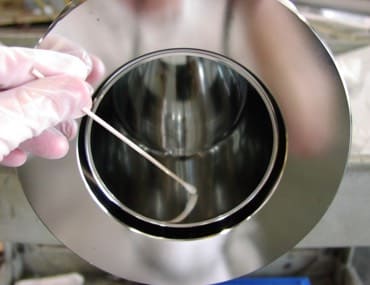
Electropolishing reduces the appearance of rouging on the inside surfaces of distillation columns, storage vessels, and distribution systems for hot purified water and clean steam.
iv. Deburring:
Electropolishing is naturally suited for deburring. During the electropolishing process, the current density is greater at high points and lesser at the low points within the surfaces profile. The rate of the electrochemical reaction is directly proportionate to the current density. The increased current density at the raised points forces the material to dissolve faster at these points and thus tends to level the surface material. Electropolishing will simultaneously deburr and polish the surface.
Grinding, vibration and tumbling techniques are often not suited for highly detailed or fragile parts. An adequately controlled electropolishing process can remove burrs from such components. Because electropolishing is a non-mechanical process, there is no risk of distortion and the material hardness has no bearing on the processing time or cost.
Burr removal by electropolishing is limited to burr sizes of 0.002" or less. Larger burrs require a longer process time to achieve the adequate material removal. These material removal levels may affect critical dimensions of the component. Large burr removal can be accomplished by first mechanically polishing the component then electropolishing.
v. Appearance:
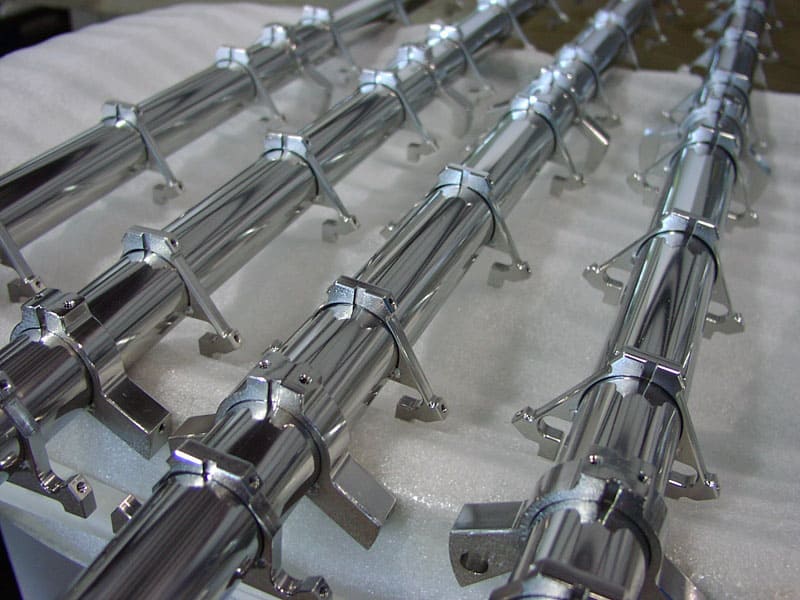
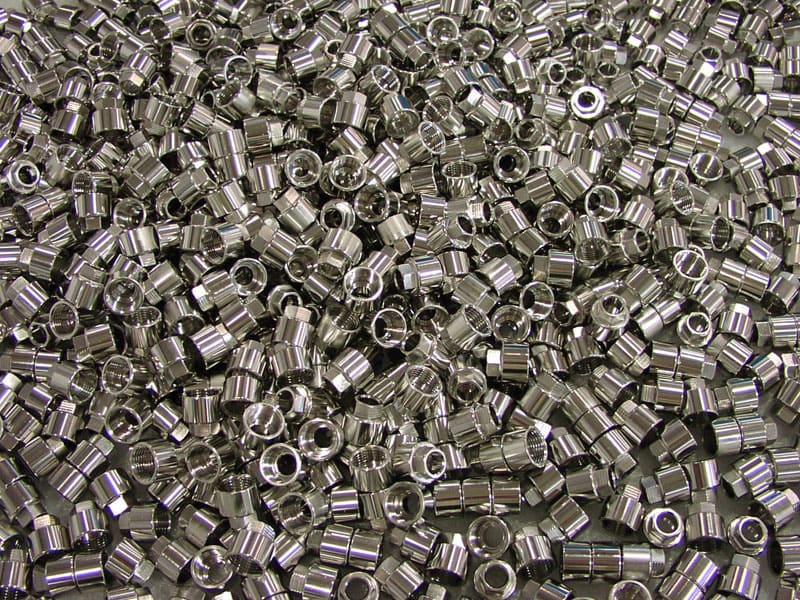
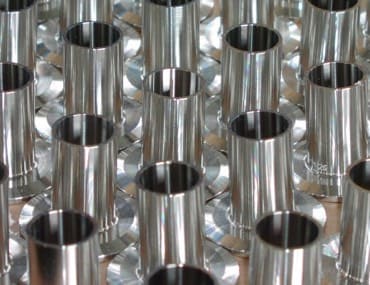
The most striking benefit of electropolishing is the resulting lustrous surface. Electropolishing is a non-mechanical process. No tools come in contact with the piece so there is no risk of creating directional polishing lines. The material is treated electrochemically, leaving a microscopically smooth surface that is highly lustrous.
Harrison Electropolishing Capabilities
Harrison Electropolishing, located in Houston, Texas, operates within a 16,000 square foot facility constructed in 2001. Included in this facility is a 360 square foot cleanroom, 2,500 square feet of office space and over 12,000 square feet of operational floor space.
Harrison Electropolishing has four electropolishing lines operating on a daily basis. Components that can fit within our operating tanks can be processed and returned on a standard production basis (typically 3 to 6 working days). While most process equipment may fit within these operating tanks, Harrison Electropolishing has developed proprietary techniques in order to electropolish larger components. These proprietary techniques allow us to process equipment of any size.
Our material handling is facilitated by five crane assemblies, including two 5-ton overhead cranes.
Metal Finishing Services
Electropolish Services from Harrison Electropolishing

Electropolishing
View Printable Version