The Benefits of Electropolishing
Reviewed by Tom Harrison, member of the ASME BPE Surface Finish Subcommittee · Updated October 2026
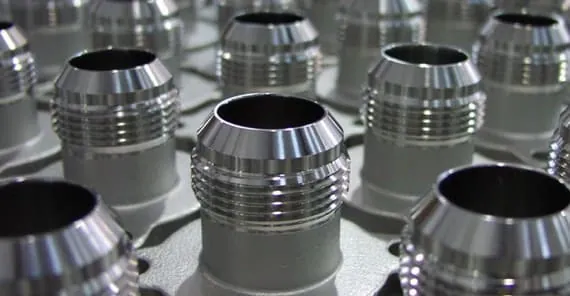
The short answer: Electropolishing does five things to a stainless steel or nickel-alloy surface that no mechanical finish does at once: it makes the surface more corrosion-resistant by removing embedded iron and enriching it in chromium, it lowers surface roughness, it reduces product adhesion and biofilm so equipment cleans faster, it deburrs without distortion, and it leaves a bright, non-directional finish. Each benefit comes from the same mechanism — dissolving the damaged outer layer of metal rather than smearing it — which is why the improvements are permanent and cannot peel or wear off like a coating.
1. Improved corrosion resistance
All corrosion starts at the surface, and every fabrication step damages it. Machining, welding, grinding and handling embed iron and abrasive particles and disrupt the chromium-oxide film that gives stainless steel its corrosion resistance. Those sites are where pitting begins.
Electropolishing dissolves free iron, inclusions and embedded particles out of the surface and, because iron dissolves preferentially, leaves the surface with a higher ratio of chromium to iron. Auger electron spectroscopy of electropolished 316L shows the effect directly. The passive oxide that re-forms on that surface is thicker and more uniform: a chromium-to-iron ratio greater than 1.5, a chromium-oxide-to-iron-oxide ratio greater than 2.0, and an oxide layer thicker than 30 angstroms are the figures Harrison works to. The practical result is better resistance to pitting, crevice corrosion, localized galvanic corrosion, stress-corrosion cracking and microbiologically influenced corrosion. More on the improved corrosion resistance page.
2. Improved surface finish
Surface roughness is measured with a profilometer, which draws a diamond stylus across the surface and reports Ra in micro-inches or micrometres. Electropolishing removes the peaks of that profile and can improve a reading by up to 50 percent. A lower Ra does more than look better: it improves seals, lowers friction, reduces real surface area, and makes the surface easier to sanitize. Because electropolishing is not a coating, there is nothing to distort, crack or peel later. See calculating surface finishes for how Ra and RMS relate.
3. Reduced product adhesion and easier cleaning
A smoother, featureless surface holds less product and less contamination. Buildup slows, duty cycles lengthen, and when cleaning is needed it takes less time and less chemistry. USDA research has indicated that electropolishing reduces the buildup of bacterial biofilms, which is why it is the standard for hygienic and bioprocess equipment, and it reduces rouging on the interior of distillation columns, storage vessels and hot purified-water and clean-steam distribution systems. See reducing product adhesion.
4. Deburring without distortion
Current density is highest on burrs and sharp edges, so electropolishing removes burrs up to about 0.002 inch during the same cycle that polishes the surface. Grinding, vibratory finishing and tumbling are hard on detailed or fragile parts; electropolishing is non-mechanical, so there is no distortion, and material hardness has no effect on time or cost. Larger burrs are mechanically polished first, then electropolished, so that material removal does not reach critical dimensions.
5. Appearance
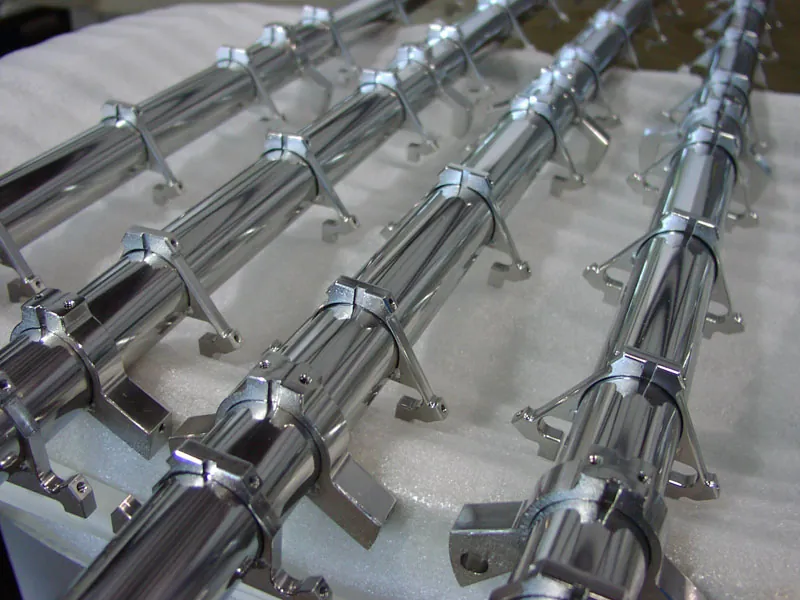
Because no tool touches the part, there are no directional polishing lines. The surface is microscopically smooth and highly lustrous, and it stays that way because the brightness is a property of the metal rather than a layer on top of it. For marine hardware, architectural and food-equipment stainless, this is often the reason the job is ordered; the corrosion resistance comes along with it.
Getting the benefit you specified
The benefits above are real only if the process is controlled and verified. Harrison documents every job with a certificate of conformance, provides profilometer Ra readings for finish-specified work, and can provide chromium-to-iron ratio results confirming the passive layer. Work is performed to ASTM B912, SEMI F19, ASME BPE or your company specification.
Request a Quote · Call 800-245-5707
- More to Know
Frequently Asked Questions

Services
Resources
13002 Brittmoore Park Dr
Houston, TX 77041-7231
Phone: 800-245-5707