Electropolishing for Solar and Polysilicon Production Equipment
The short answer: Polysilicon and solar-cell manufacturing use the same ultra-high-purity surfaces as the semiconductor industry: chemical vapor deposition (CVD) reactors, UHP gas and chemical delivery lines, and process chambers where any particle or metallic contaminant ends up in the product. Harrison has performed high-luster polishing of CVD reactors used for polysilicon production and electropolished transfer lines for ultra-high-purity polycrystalline producers. The work is done under an ISO 9001 quality system with Ra documentation and certificates of conformance.
What we finish for solar and polysilicon customers
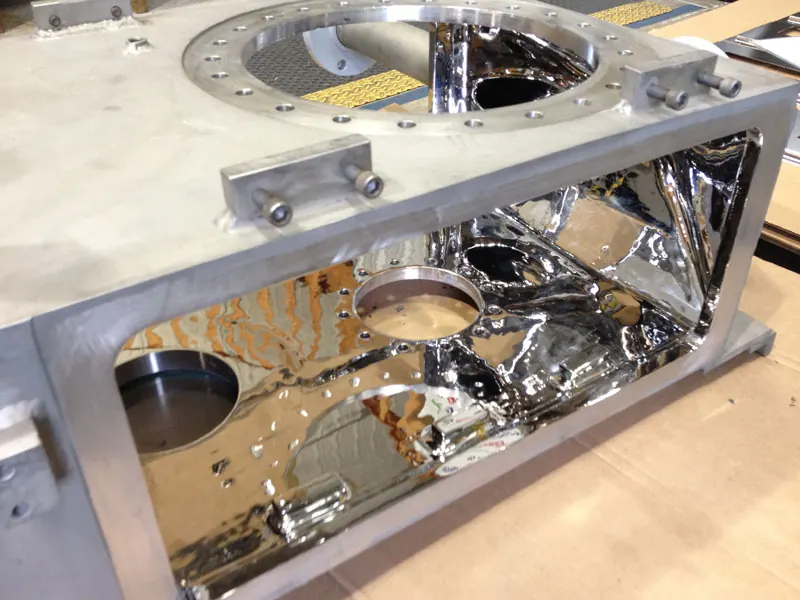
CVD reactor bells and bases. High-luster mechanical polishing and electropolishing of reactor interiors used to deposit polysilicon.
UHP gas and chemical delivery lines. Electropolished tubing, manifolds and fittings for silane, trichlorosilane and process-gas service, cleaned and packaged for installation.
Process chambers, vessels and transfer lines. Interior electropolishing to a specified Ra to reduce particle generation and contamination.
Wafer-handling and wet-process hardware. Stainless components electropolished and passivated for chemical resistance and cleanability.
Why electropolished surfaces are the standard
Electropolishing removes the outer layer of metal along with embedded iron and the smeared, stressed surface left by machining. What remains is a chromium-enriched, featureless surface that sheds fewer particles, outgasses less, resists corrosive process chemistry and cleans completely. For a polysilicon producer that means less contamination of the deposited silicon and longer intervals between reactor cleanings. Work is performed to ASTM B912 and the customer's surface-roughness specification; see our semiconductor page for SEMI F19 and UHP cleaning and packaging practice.
Capacity
The Houston facility has four overhead cranes and 15,000 lb material-handling capacity for reactor sections and large vessels. Harrison has polished high-purity equipment for solar and semiconductor producers since 1980, is ISO 9001 and ISO 14001 certified, and offers expedited service; lead times vary with shop load.
Representative project
A polysilicon producer expanding capacity needed the interiors of a set of CVD reactor bells polished to a high-luster finish and the connecting stainless transfer lines electropolished to a specified Ra before installation. Harrison mechanically polished and electropolished the reactor interiors, electropolished the transfer lines and fittings, verified surface roughness, cleaned and packaged the components, and delivered Ra readings with certificates of conformance. The equipment was installed without rework.
Request a solar equipment quote
Tell us the component, the alloy, the Ra or finish specification, the cleaning and packaging required, and your delivery date. We quote within one business day.
Request a Quote · Call 800-245-5707
- More to Know
Frequently Asked Questions

Services
Resources
13002 Brittmoore Park Dr
Houston, TX 77041-7231
Phone: 800-245-5707