Carbon Steel Mechanical Polishing
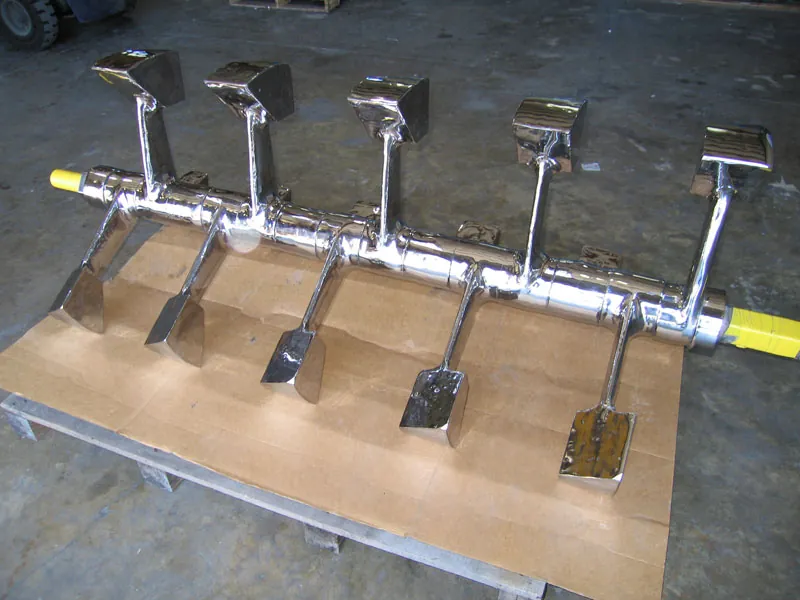
The short answer: Carbon steel is not electropolished — the process depends on a chromium-bearing alloy — but it is polished, and more often than most people expect. Carbon steel exchangers, valves, mixers, reactor piping and product-transfer piping are mechanically polished to a specified Ra to improve surface finish, reduce product adhesion and make the equipment easier to clean. Harrison mechanically polishes carbon steel from as-cast to finely machined surfaces, in the shop or on-site, and certifies the finish with profilometer readings.
Why polish carbon steel
An as-cast or as-machined carbon steel surface has the same problem as rough stainless: product keys into the peaks and tool marks, builds up, slows transfer and forces cleaning shutdowns. Mechanical polishing removes those peaks and leaves a surface that releases product and cleans faster. On exchangers and reactor piping it also removes the roughness that fouling starts on. For carbon steel that will be coated or lined, a controlled mechanical finish is the right substrate.
What we polish
Heat exchangers and tube bundles, valves and valve bodies, mixers and agitators, reactor piping and internals, product-transfer piping, hoppers and chutes, dies and molds, and fabricated vessels. Harrison's polishing team uses tooling and techniques developed for process-equipment geometry — the same precision mechanical polishing that is the first stage of the Harrison C-75 process on stainless. Large equipment is handled in Houston with four overhead cranes and 15,000 lb material-handling capacity; installed equipment is polished on-site across the Houston area and the Gulf Coast.
Specifying the finish
Give us the Ra target or the problem you are solving, the component and its dimensions, and whether the surface will be coated afterward. We quote within one business day and ship with a certificate of conformance and Ra readings. Related: mechanical polishing and reducing product adhesion.
Request a Quote · Call 800-245-5707
- More to Know
Frequently Asked Questions

Services
Resources
13002 Brittmoore Park Dr
Houston, TX 77041-7231
Phone: 800-245-5707