Mechanical Polishing Services for Stainless Steel and Specialty Alloys
Reviewed by Tom Harrison, member of the ASME BPE Surface Finish Subcommittee · Updated October 2026
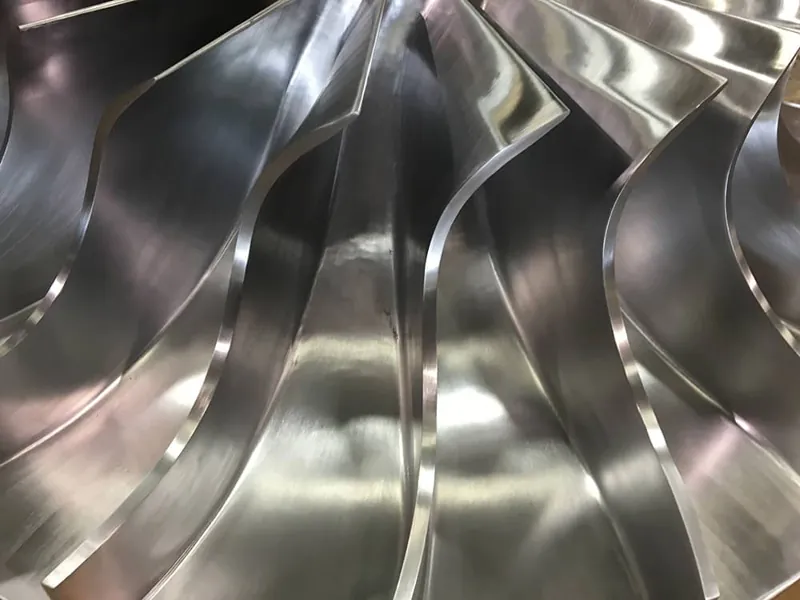
The short answer: Mechanical polishing smooths a surface with abrasives, in steps of progressively finer grit, until it reaches a specified finish — a #4 brushed finish, a #8 mirror, or a measured Ra. It removes material and works the surface, changing both the macroscopic and microscopic texture. Harrison polishes stainless steel, nickel alloys, aluminum, titanium and carbon steel, from deburring a casting to ultra-fine finishes for high-purity equipment, certifies finishes as low as 4 µin Ra with profilometer readings, and does the work in Houston or on-site. For stainless and nickel alloys, mechanical polishing is also the first stage of the Harrison C-75 process and the route to ASME BPE SF4 and semiconductor finishes when followed by electropolishing.
Finishes we produce
Ra-specified finishes. Polished to a maximum Ra on the drawing and verified with a profilometer; certified as low as 4 µin Ra.
#4 brushed finish. The general-purpose directional finish produced with 120–150 grit abrasive, used on architectural, food-equipment and general process surfaces.
#8 mirror finish. Produced with successively finer abrasives and buffing; used where reflectivity or the lowest mechanical Ra is required.
ASME BPE SF1–SF3. Mechanically polished product-contact finishes at 20, 25 and 30 µin Ra max for bioprocess equipment; SF4–SF6 add electropolishing. See ASME BPE specifications.
Deburring and restoration. Removal of burrs, tool marks and casting texture; restoration of worn, scratched or corroded surfaces before re-finishing.
Materials
Stainless steel, nickel alloys including Hastelloy and Inconel, aluminum, titanium and carbon steel. Harrison keeps tooling and abrasives for aluminum and titanium separate from steel to avoid cross-contaminating the surface.
Why mechanical polishing
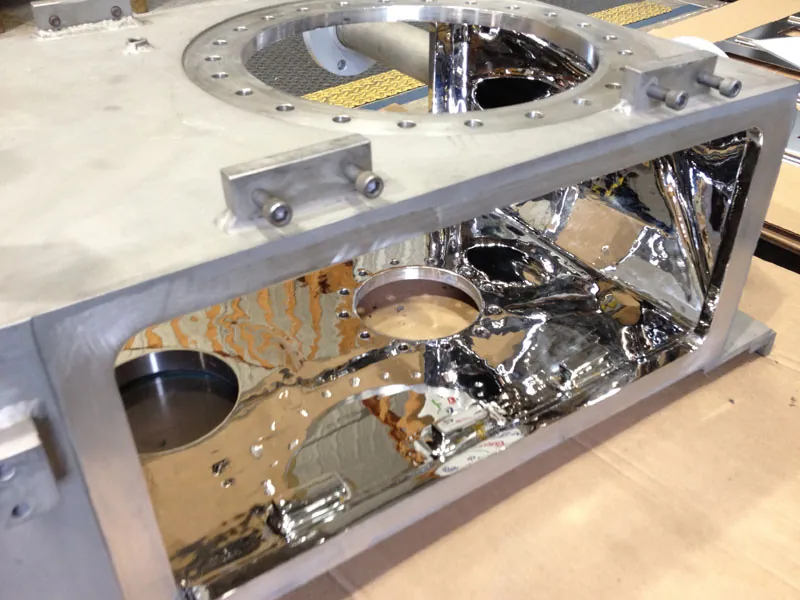
A lower Ra reduces product adhesion and buildup, improves cleanability and sanitation, improves seals and reduces friction, and gives a uniform appearance. On materials that cannot be electropolished — aluminum, titanium, carbon steel — it is the only route to a specified finish. On stainless and nickel alloys it is the way to reach a finish lower than electropolishing alone can produce, since electropolishing improves a surface by about half its starting Ra.
Specifications
| Specification | Scope |
|---|---|
| ASME BPE | Surface-finish designations for bioprocessing equipment |
| NiDI No. 9012 | Nickel Institute reference for stainless steel mechanical finishes (#2B, #4, #8 and others) |
| ASME B46.1 | Surface texture — roughness, waviness and lay — and how Ra is measured |
Finish-specified work ships with profilometer Ra readings and a certificate of conformance.
Capacity, turnaround and certifications
Facility: 25,000 sq ft in northwest Houston, expanded and updated in 2021, with four overhead cranes and 15,000 lb material-handling capacity; polishing tooling and techniques developed over more than four decades for process-equipment geometry. On-site service: across the Houston area and Gulf Coast, parts too large or too fixed to transport are polished at your facility. Turnaround: expedited service is available and lead times vary with shop load; quotes go out within one business day. Hours: Monday–Friday, 7:00 AM – 5:00 PM. Quality system: ISO 9001:2015 and ISO 14001:2015 registered, with a certificate of conformance on every job and full traceability from receipt to release. Local to Houston? See electropolishing and passivation in Houston.
Request a Quote · Call 800-245-5707
- More to Know
Frequently Asked Questions

Services
Resources
13002 Brittmoore Park Dr
Houston, TX 77041-7231
Phone: 800-245-5707