Nickel Alloys: Passivation, Polishing and Cleaning
The short answer: Nickel alloys — Inconel, Monel, Incoloy, Hastelloy, Alloy 20, Nickel 200 series, Kovar and the rest — are specified for corrosion resistance and strength at temperature, and every one of them arrives from fabrication with embedded iron, oxides and a work-damaged surface. Harrison provides the full set of surface processes for nickel alloys: electropolishing, chemical passivation, precision mechanical polishing certified as low as 4 µin Ra, and chemical and oxygen cleaning. This page covers passivation, polishing and cleaning; electropolishing is detailed at nickel alloy electropolishing.
Passivation of nickel alloys
Passivation chemically removes free iron, oxides and embedded surface impurities without changing the surface or dimensions, and is commonly used to restore the corrosion resistance of nickel alloys after machining, welding and handling. Harrison passivates nickel-alloy components of all sizes to ASTM A967, ASTM A380 or your company specification, with verification and a certificate of conformance.
Mechanical polishing of nickel alloys
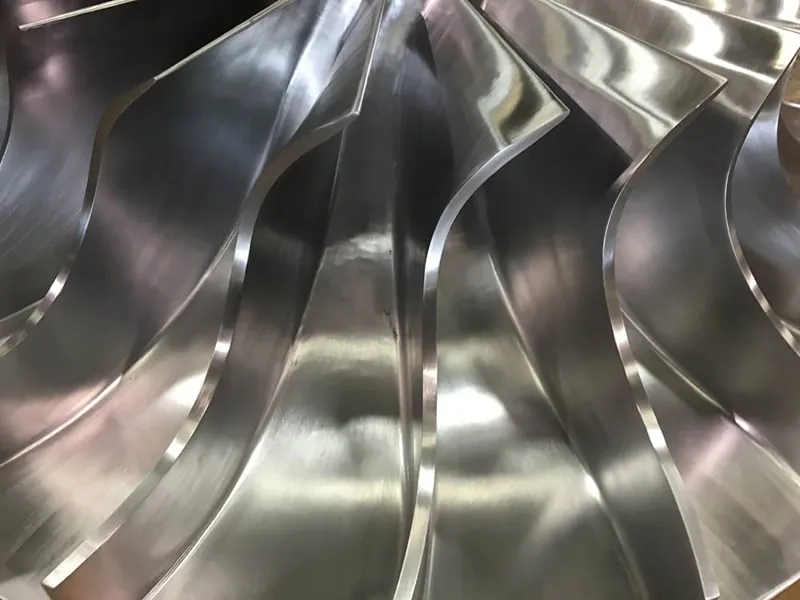
For a specified Ra on seal faces, reactor internals, aerospace hardware or pharmaceutical equipment, Harrison mechanically polishes nickel alloys and certifies finishes as low as 4 µin Ra with profilometer readings. Mechanical polishing is also the first stage before electropolishing when the target is lower than electropolishing alone can reach.
Chemical and oxygen cleaning
Nickel-alloy valves, fittings, regulators, piping and vessels for oxygen, industrial-gas, cryogenic and high-purity service are cleaned to CGA G-4.1 and ASTM G93 practice, verified and packaged clean; see oxygen cleaning. Chemical cleaning removes scale, process residues and contamination from equipment in service.
Alloys and typical components
Inconel 600, 625, 718, X-750 and 800 · Monel 400 and K-500 · Incoloy · Hastelloy grades · Alloy 20 (20Cb-3) · Nickel 200, 205, 220 and 270 · Waspaloy · Kovar and Alloy 42 · Permalloy and Mu-metal. Typical components are reactor internals, heat-exchanger tubes and bundles, valve bodies and trim, pump components and impellers, gas-turbine and aerospace hardware, cryogenic and gas-system components, and electronic and vacuum parts. Large fabrications are handled in Houston with four overhead cranes and 15,000 lb material-handling capacity; installed equipment is passivated and cleaned on-site.
Request a Quote · Call 800-245-5707
- More to Know
Frequently Asked Questions

Services
Resources
13002 Brittmoore Park Dr
Houston, TX 77041-7231
Phone: 800-245-5707