Hastelloy Passivation
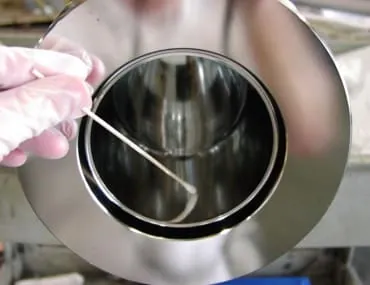
The short answer: Hastelloy (a registered trademark of Haynes International) is specified for the environments that attack stainless steel — hot chlorides, mixed acids, wet chlorine, sour gas — and that resistance depends on a clean surface. Grease, dirt, free iron and other metallic particles are inherent to fabrication, and they corrode before the alloy does. Passivation treats the surface with a mild oxidant that removes those contaminants without changing the finish or dimensions, so the alloy performs as engineered. Harrison has passivated Hastelloy for decades, to ASTM A967, ASTM A380 or your specification, on components of all sizes, in Houston and on-site.
What passivation does for Hastelloy
Removes free iron picked up from steel tooling, fixtures and shop handling; removes grease, dirt and process contamination; leaves the nickel-chromium-molybdenum surface clean so its own passive film forms uniformly. It does not remove heat tint or weld oxide — those are pickled first — and it does not smooth or brighten; for that, see Hastelloy electropolishing.
Process and verification
Pre-cleaning; immersion or circulation in a passivation bath with chemistry and parameters set for nickel-chromium-molybdenum alloys; deionized-water rinse; drying; verification and a certificate of conformance naming the specification and method.
Typical Hastelloy components
Reactor and column internals, heat-exchanger tubes and bundles, valve bodies and trim, pump casings and impellers, scrubber and flue-gas hardware, chemical-process piping and fittings, and pharmaceutical and fine-chemical equipment in C-22. Large fabrications are handled in Houston with four overhead cranes and 15,000 lb material-handling capacity; installed equipment is passivated on-site across the Houston area and the Gulf Coast.
For mechanical polishing certified as low as 4 µin Ra, chemical cleaning and oxygen cleaning of Hastelloy, see Hastelloy under materials.
Request a Quote · Call 800-245-5707
- More to Know
Frequently Asked Questions
Services
Resources
13002 Brittmoore Park Dr
Houston, TX 77041-7231
Phone: 800-245-5707