Semiconductor Electropolishing and Ultra-High-Purity Surface Finishing
Reviewed by Tom Harrison, Founder & CEO, member of the ASME BPE Surface Finish Subcommittee · Updated October 2026
The short answer: Semiconductor process equipment lives or dies on surface condition. Gas panels, UHP tubing, weldments, chamber components, showerheads and wafer-handling hardware are specified to SEMI F19 (wetted surface condition), ASTM B912 and ASME BPE-style Ra limits because a rough, iron-contaminated or particle-shedding surface contaminates the process gas and, eventually, the wafer. Harrison electropolishes and passivates these components in Houston — in the middle of the Texas semiconductor corridor — and has been an approved vendor to Applied Materials for critical electropolishing work. We finish 316L and higher alloys to low-Ra, chromium-enriched surfaces, verify them, and package them in a Class 1000 cleanroom.
What we finish for semiconductor customers
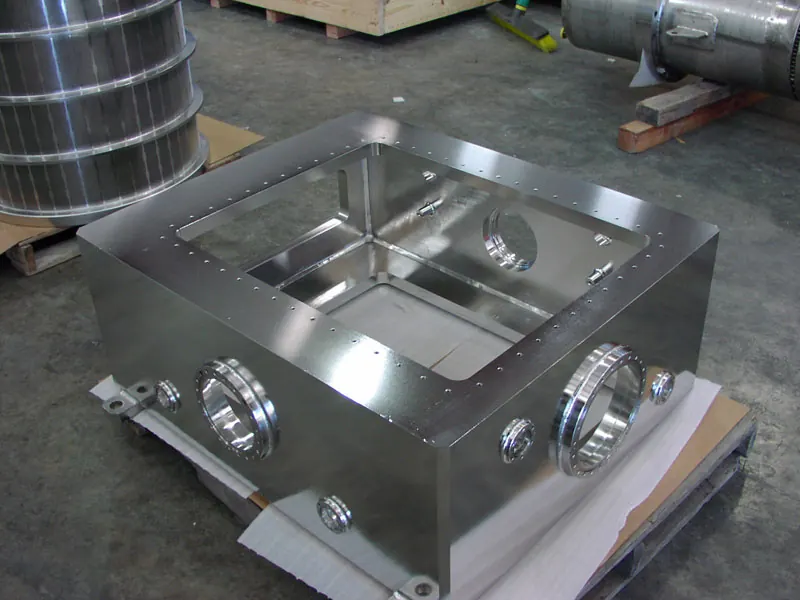
Gas delivery hardware. Gas panels, valve manifold boxes, weldments, fittings and UHP tubing are electropolished to reduce Ra and remove the embedded iron and smeared metal that machining and orbital welding leave behind. A smoother, chromium-rich surface outgasses less, holds less moisture and sheds fewer particles into the process gas stream.
Chamber and tool components. Process chamber parts, showerheads, liners, pedestals and vacuum hardware are electropolished and passivated to restore a clean, passive surface after machining or refurbishment. Electropolishing is a controlled material-removal process, so dimensional allowances are agreed before the part goes in the tank; see how to specify electropolishing on a drawing.
Wafer handling and automation. End effectors, carriers, brackets and frames in stainless steel and aluminum are polished and passivated for low particle generation and easy cleaning.
Large and oversized hardware. Frames, sub-fab piping, exhaust components and tool bases that most electropolishers cannot fit are handled in our 25,000 sq ft facility with four overhead cranes and 15,000 lb material-handling capacity, or on-site by our field crews.
Specifications and what they mean for your parts
SEMI F19 defines the surface condition of wetted stainless components in gas systems, including Ra limits and surface chemistry. ASTM B912 is the standard for passivation of stainless steel by electropolishing. ASME BPE surface-finish designations (SF4–SF6) are frequently borrowed for semiconductor wetted surfaces; our ASME BPE guide explains the Ra table. ASTM A967 and A380 govern chemical passivation of parts that will not be electropolished. Electropolishing typically reduces Ra by 30–50% from the starting surface, so the mechanical pre-finish determines the achievable result; tell us your starting condition and target and we'll confirm what is reachable.
Cleaning, verification and packaging
High-purity work is only as good as what happens after the tank. Electropolished and passivated semiconductor parts are rinsed with deionized water, verified for passivation per ASTM A967 where specified, measured for Ra where specified, dried, and packaged in our Class 1000 cleanroom with capped openings and double bagging. Certificates of conformance, Ra reports and lot traceability ship with every order.
Representative project
A semiconductor equipment manufacturer needed a recurring supply of 316L gas-panel weldments and fittings electropolished to a low-Ra, passive surface for a UHP gas delivery product line, with documentation suitable for their supplier-quality audit. Harrison qualified the parts through first-article inspection, established fixturing and cathode placement to hold Ra on the internal passages, and now processes the components on a repeat schedule with per-lot Ra reports and certificates of conformance, cleanroom-packaged for direct release to the customer's assembly floor.
Texas and the national semiconductor build-out
New and expanding fabs and tool-maker operations in Taylor, Sherman, Austin and the Dallas–Fort Worth corridor, plus the Arizona, Idaho, New York and Oregon build-outs, all draw on the same supply chain of gas-system integrators, chamber-parts houses and mechanical contractors. Harrison supplies electropolishing and passivation to that chain from Houston, with the capacity for both small repeat lots and the large hardware other shops turn away.
Request a semiconductor quote
Send the drawing, alloy, quantity and the specification — SEMI F19, ASTM B912, an Ra target or your own supplier spec — and we'll quote within one business day. Expedited service is available; lead times vary with shop load.
Request a Quote · Call 800-245-5707
- More to Know
Frequently Asked Questions

Services
Resources
13002 Brittmoore Park Dr
Houston, TX 77041-7231
Phone: 800-245-5707