Pickling and Passivation: What Each Removes and When You Need Both
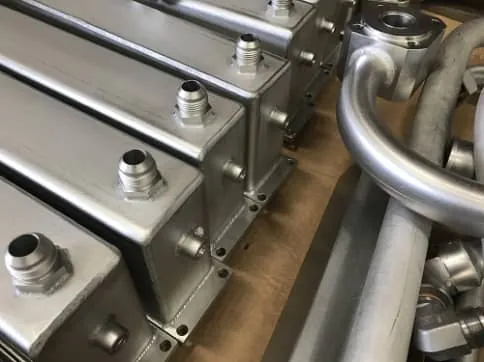
The short answer: Pickling and passivation solve different problems and are usually done in that order. Pickling uses aggressive acids to dissolve weld scale, heat tint, rust, embedded particles and other oxides, and it etches the base metal slightly. Passivation uses a mild oxidant — nitric or citric acid — to remove free iron without attacking the surface, so the chromium-oxide passive film re-forms. Passivation alone cannot remove oxides; pickling alone leaves an active surface. A welded stainless fabrication going into corrosive service normally needs both. Harrison has done both since 1980 and can pickle large components by immersion, circulation or spray.
Pickling
Pickling is for the heavy work: removing the oxides, scale and heat tint that welding, heat treatment and high-temperature service leave on stainless and corrosion-resistant alloys, along with embedded iron and surface contamination. The acids are strong enough to dissolve the oxide and a thin layer of the metal beneath it, which is why pickling leaves a uniform matte surface and why it is controlled for time and temperature. Harrison pickles components of all sizes by immersion, by circulating the solution through piping and vessels, or by spray application on large fabrications and installed equipment, to ASTM A380 or AMS specifications or your standard. Details on the pickling services page.
Passivation
Passivation is the finishing step. The mild oxidant removes free iron and foreign matter that would prevent the passive film from forming, and the surface re-passivates in air. Passivation does not change the finish or dimensions and does not remove oxides — which is why a welded part that is only passivated still has heat tint, and the heat tint still corrodes. Harrison passivates to ASTM A967, ASTM A380 and AMS 2700 with nitric or citric acid; see the passivation page.
When to use which
Welded or heat-treated fabrication: pickle, then passivate. Machined parts with no scale: passivate only. Rusted or stained equipment in service: pickle to remove the corrosion products, then passivate. Surface must also be smooth, bright or cleanable: pickle if needed, then electropolish, which passivates the surface as part of the process. We will tell you which your part needs when you send the drawing and the service conditions.
Capacity
Four overhead cranes and 15,000 lb material-handling capacity in Houston; immersion, circulation and spray pickling for large components; and field crews that pickle and passivate installed equipment across the Houston area and the Gulf Coast. ISO 9001 and ISO 14001 certified, certificate of conformance on every job.
Request a Quote · Call 800-245-5707
- More to Know
Frequently Asked Questions
Services
Resources
13002 Brittmoore Park Dr
Houston, TX 77041-7231
Phone: 800-245-5707