Stainless Steel Passivation
The short answer: When stainless steel rusts, the alloy is almost never the problem — the surface is. Fabrication, welding and handling leave free iron, embedded particles and weld oxides that break the chromium-oxide film and start corrosion. Stainless steel passivation is a chemical treatment with a mild oxidant, nitric or citric acid, that removes those contaminants so the passive film re-forms intact. Harrison has passivated stainless steel since 1980, to ASTM A967, ASTM A380, AMS 2700 or your specification, in Houston and on-site, with verification and a certificate of conformance on every job.
Why stainless steel rusts and how passivation fixes it
All stainless steels contain at least 10.5 percent chromium, which reacts with oxygen to form a thin, self-healing passive film. Steel tooling, grinding, welding and shop handling embed free iron in the surface and leave oxides over the welds; the passive film cannot form over them, and those spots rust and pit in service. Passivation dissolves the free iron and contaminants without attacking the base metal, leaving a clean, chromium-rich surface that passivates itself. It does not change the finish, the dimensions or the appearance of the part. Where there is weld scale or heat tint, pickling is done first; see passivation and pickling.
Grades we passivate
Austenitic 304, 304L, 316 and 316L — the bulk of process-equipment work; both nitric and citric methods apply.
Duplex 2205 and super duplex — passivated after fabrication to restore chloride resistance in oil and gas and chemical service.
Precipitation-hardening 17-4 PH and 15-5 PH — passivated to AMS 2700 or ASTM A967 for aerospace, pump and valve components; method selected for the grade.
400-series martensitic and ferritic stainless — 410, 416, 420, 430 and similar, which need a method and chemistry chosen for the grade to avoid etching.
6Mo alloys such as AL-6XN — see AL-6XN passivation.
Specifications and verification
ASTM A967 (nitric and citric methods and the verification tests), ASTM A380 (cleaning, descaling and passivation of parts, equipment and systems), SAE AMS 2700 (aerospace) and the superseded federal QQ-P-35, which older drawings still reference. Verification is by the test the specification requires — copper sulfate, ferroxyl, water immersion or high humidity — and is recorded on the certificate of conformance. Where the drawing also calls for an electropolished surface, ASTM B912 applies; see stainless steel electropolishing.
Typical work
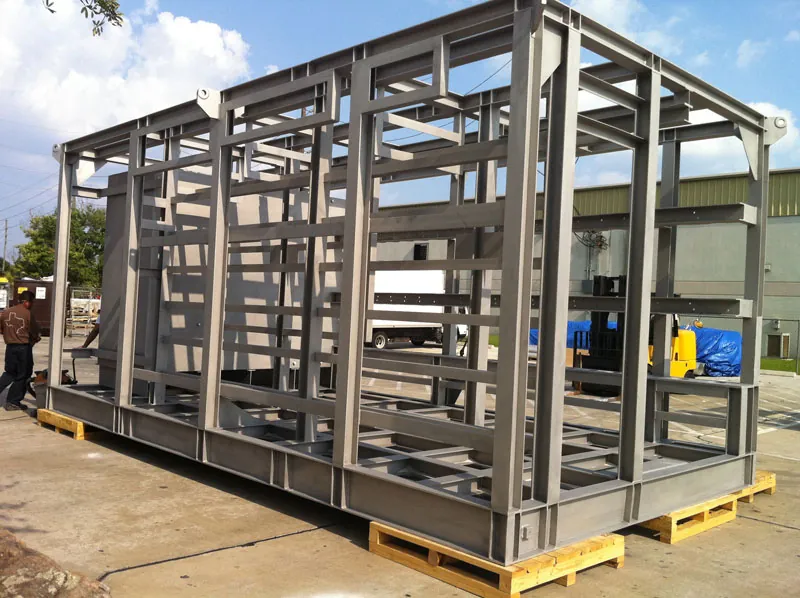
Hygienic tubing and spools, valves and fittings, tanks and vessels, skids, heat exchangers, structural frames and enclosures, machined and fabricated parts in any quantity. Large fabrications are handled in Houston with four overhead cranes and 15,000 lb material-handling capacity; installed piping and vessels are passivated on-site across the Houston area and the Gulf Coast. Expedited service is available and lead times vary with shop load.


Request a Quote · Call 800-245-5707
- More to Know
Frequently Asked Questions

Services
Resources
13002 Brittmoore Park Dr
Houston, TX 77041-7231
Phone: 800-245-5707