Aerospace & Space: Passivation, Electropolishing and Oxygen Cleaning for Flight and Ground Hardware
Reviewed by Tom Harrison, Founder & CEO, member of the ASME BPE Surface Finish Subcommittee · Updated October 2026
The short answer: Aerospace and space hardware needs three things from a metal finisher: a passive, iron-free surface on stainless, titanium and nickel alloys (AMS 2700, ASTM A967, ASTM B912); verified cleanliness for anything that touches oxygen, LOX or propellant (ASTM G93, CGA G-4.1, MIL-STD-1330); and documentation that follows the part — certificates of conformance, test results and traceability to the lot. Harrison Electropolishing has done all three in Houston since 1980, 25 miles from NASA Johnson Space Center and the Houston Spaceport, with a 25,000 sq ft facility, four overhead cranes, 15,000 lb handling capacity and a Class 1000 cleanroom for oxygen-service packaging.
Where our processes fit on a vehicle or ground system
Oxygen and propellant systems. LOX and GOX lines, regulators, valves, flex hoses, cryogenic transfer lines, test-stand plumbing and ground-support equipment are cleaned to the cleanliness level your specification calls out, verified by the methods CGA G-4.1 and ASTM G93 prescribe, and double-bagged, capped and labeled for oxygen service. Electropolishing before cleaning produces a smoother, lower-particle surface that is easier to clean and verify.
Structural and fluid-system stainless. Machined fittings, fasteners, brackets, hydraulic tubing and manifolds are passivated to AMS 2700 or ASTM A967 after machining and welding so the free iron left by tooling cannot start corrosion in service. Nitric and citric methods are both run in-house; see citric vs. nitric passivation for how to choose when the drawing leaves it open.
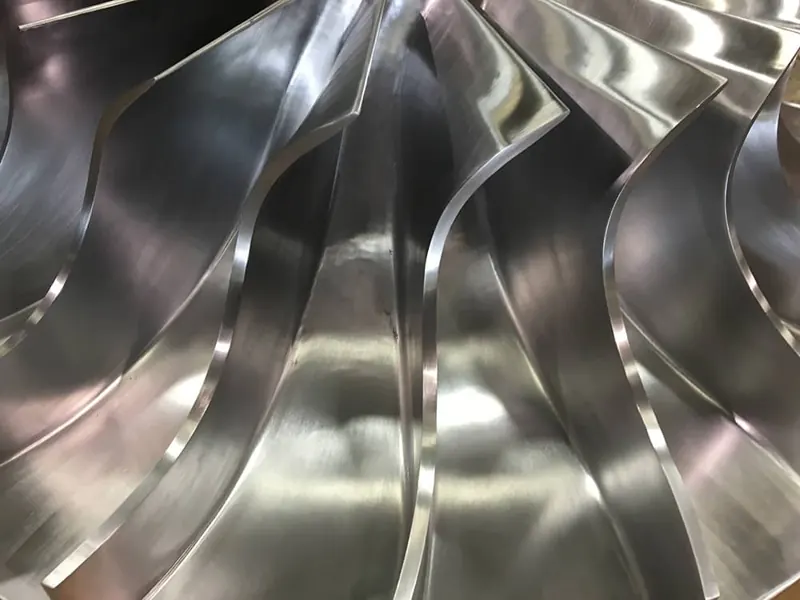
Titanium, Inconel and other alloys. Titanium, nickel alloys and Hastelloy components are passivated and electropolished for cryogenic and high-temperature service. Electropolishing removes the smeared, stressed surface layer from machining and leaves a bright, chromium-enriched (or oxide-stable, in titanium's case) surface with fewer crevices for contaminants.
Precision cleanliness for spacecraft hardware. Components headed for vacuum, propulsion or life-support service are processed in our Class 1000 cleanroom, dried with filtered oil-free gas, capped and bagged, with the cleaning method and verification stated on the certificate.
Specifications we work to
AMS 2700 (passivation of corrosion-resistant steels, Methods 1 and 2) · ASTM A967 and ASTM A380 · ASTM B912 (electropolishing) · ASTM G93 and CGA G-4.1 (oxygen service cleanliness) · MIL-STD-1330 · EIGA 33 · customer and prime specifications supplied with the purchase order. Our quality system is registered to ISO 9001:2015 and ISO 14001:2015.
If your purchase order references a NASA cleanliness level, a prime's special-process specification or an outside-vendor cleaning clause, send it with the drawing. We quote to the document, not to a generic process.
Documentation that ships with the parts
Certificate of conformance naming the specification, method and cleanliness level; ASTM A967 passivation verification results where required; surface finish (Ra) reports for electropolished surfaces; material traceability by heat or lot; photographs of as-received condition on request. Parts are tagged and bagged by line item so receiving inspection can match them to the PO without opening the bag.
Representative project
A Gulf Coast launch-services supplier needed a set of 316L and Inconel cryogenic valve bodies and transfer-line spools cleaned for liquid oxygen service before integration. The parts arrived with machining oils and heat tint from welding. Harrison pickled and passivated the stainless, electropolished the wetted surfaces to reduce particle generation, then oxygen-cleaned and verified every component to the cleanliness level on the specification, packaged in the cleanroom, double-bagged with capped ports, and shipped with a certificate of conformance and test results per line item. The customer's incoming inspection accepted the lot without rework.
Why Houston matters for space work
Axiom Space, Intuitive Machines and the Houston Spaceport ecosystem are a short drive from our door; NASA JSC is 25 miles away. That means site visits, witnessed testing and hand delivery are practical, and oversized ground-support hardware that can't ship easily can be processed on-site by our field crews anywhere in the Houston area and along the Gulf Coast.
Request an aerospace quote
Send the drawing, material, quantity and the governing specification — AMS 2700 type, ASTM G93 level, Ra target or the prime's spec number — and we'll quote within one business day. Expedited service is available; lead times vary with shop load, so tell us your need date.
Request a Quote · Call 800-245-5707
- More to Know
Frequently Asked Questions

Services
Resources
13002 Brittmoore Park Dr
Houston, TX 77041-7231
Phone: 800-245-5707