Pickling, Passivation and Electropolishing for Petrochemical Equipment
The short answer: Petrochemical plants along the Gulf Coast need two things from a stainless surface: corrosion resistance that survives the process, and a finish that product does not stick to. Harrison delivers both from one shop in Houston — pickling and passivation after fabrication to restore the passive layer, and electropolishing, mechanical polishing or the Harrison C-75 process on product-contact surfaces to reduce buildup, bridging and cleaning downtime. Equipment that cannot ship is handled on-site.
Components we process
Piping, spools and pipeline components. Pickled and passivated after welding; electropolished where internal smoothness is specified.
Surge hoppers, silos and resin-handling equipment. Interior polishing to reduce product adhesion and keep pellets and powders flowing.
Tanks and pressure vessels. Shop or on-site pickling and passivation; interior electropolishing for cleanability.
Heat exchangers, columns and internals. Passivation of trays, packing supports and shells after fabrication or repair.
Corrosion resistance and product adhesion are different problems
Pickling and passivation (ASTM A380 and A967) restore the corrosion resistance the alloy was designed for by removing weld heat tint, scale and free iron. They are the baseline for any stainless fabrication going into chemical service.
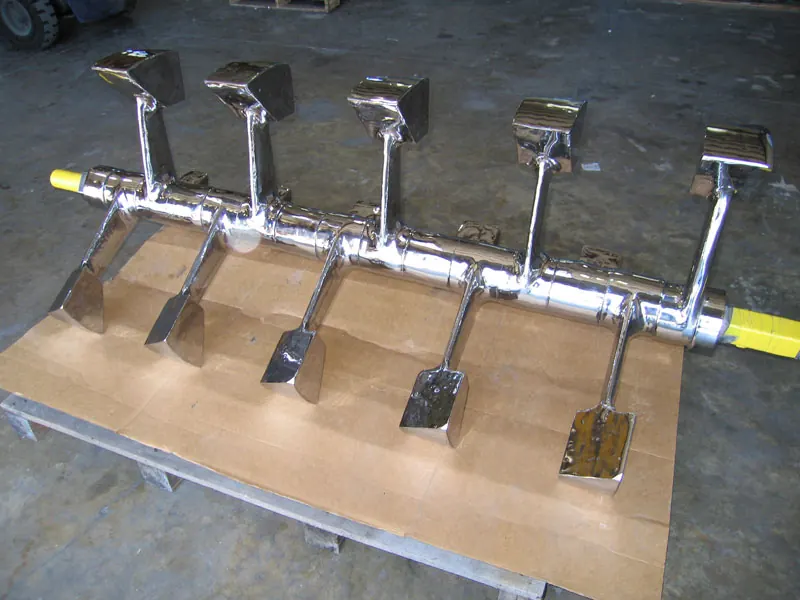
Electropolishing, mechanical polishing and C-75 address adhesion. A smoother, featureless surface lets polymer pellets, powders, resins and viscous intermediates release instead of building up. Less buildup means higher transfer rates, longer intervals between cleaning shutdowns and faster cleaning when a shutdown does come. We will recommend the process that fits the material and the specification rather than the most expensive one. See reducing product adhesion for examples.
Capacity, turnaround and field service
The Houston facility has four overhead cranes and 15,000 lb material-handling capacity. Harrison field crews pickle and passivate installed piping, tanks and vessels at plants throughout the Houston area and the Gulf Coast. We have served the petrochemical industry since 1980, are ISO 9001 and ISO 14001 certified, and offer expedited service for turnaround windows; lead times vary with shop load.
Representative project
A Gulf Coast polyolefin producer preparing for a turnaround needed a set of stainless surge hoppers and transfer piping polished to reduce pellet buildup and the welded spools pickled and passivated before reinstallation. Harrison polished the hopper interiors and spool bores, pickled and passivated the welded assemblies, verified passivation, and returned the equipment inside the turnaround window with certificates of conformance. Product buildup in the hoppers dropped and the unit's cleaning interval lengthened.
Request a petrochemical quote
Tell us the alloy, the component and dimensions, the specification or the problem you are solving (corrosion, adhesion or both), and your turnaround dates. We quote within one business day.
Request a Quote · Call 800-245-5707
- More to Know
Frequently Asked Questions

Services
Resources
13002 Brittmoore Park Dr
Houston, TX 77041-7231
Phone: 800-245-5707