Pharmaceutical Equipment Electropolishing, Passivation and De-Rouging to ASME BPE
Reviewed by Tom Harrison, member of the ASME BPE Surface Finish Subcommittee · Updated October 2026
The short answer: Pharmaceutical manufacturers specify product-contact surfaces by ASME BPE surface-finish designation (SF1–SF6), and the finish has to be proven, not promised. Harrison electropolishes, mechanically polishes, passivates and de-rouges 316L vessels, piping, valves and skids to those designations, measures Ra with a profilometer, verifies passivation, and ships every job with a certificate of conformance. Tom Harrison, our founder, sits on the ASME BPE Surface Finish Subcommittee that writes the standard your spec references.
What we finish for pharmaceutical customers
Process vessels, tanks and agitators. Interior electropolishing to SF4–SF6 after mechanical polishing removes the weld and grind marks where product and cleaning residues collect. Large vessels that cannot ship are polished and passivated on-site by our field crews.
Hygienic tubing, spools and manifolds. Orbital-welded 316L distribution systems — WFI, clean steam, product transfer — are passivated per ASTM A967 or electropolished per ASTM B912 before installation, then capped and bagged.
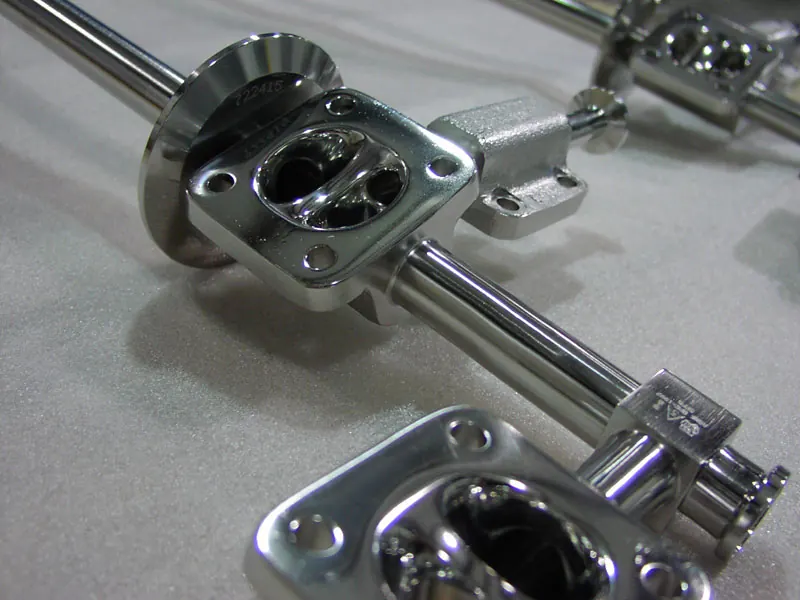
Valves, fittings, pump housings and filter housings. Small components run in batches with the same Ra and passivation verification as the vessels they bolt to.
De-rouging and re-passivation of equipment in service. Class I–III rouge on WFI systems, vessels and piping is removed chemically and the surface re-passivated, with before-and-after documentation for your change-control file.
ASME BPE surface-finish designations
| Designation | Finish | Ra max (µin) | Ra max (µm) |
|---|---|---|---|
| SF1 | Mechanically polished | 20 | 0.51 |
| SF2 | Mechanically polished | 25 | 0.64 |
| SF3 | Mechanically polished | 30 | 0.76 |
| SF4 | Mechanically polished + electropolished | 15 | 0.38 |
| SF5 | Mechanically polished + electropolished | 20 | 0.51 |
| SF6 | Mechanically polished + electropolished | 25 | 0.64 |
ASME BPE also governs weld acceptance, passivation and the documentation that travels with the equipment. We report Ra readings by location, and on request supply chromium-to-iron ratio results confirming the passive layer. See what is ASME BPE and electropolishing vs passivation for how the two processes differ.
Why surface finish matters in pharma
An electropolished surface is microscopically featureless, so it holds less residue, cleans faster in CIP and SIP cycles, and resists the rouge and corrosion that start in grind marks and weld heat-affected zones. Lower Ra also means fewer sites for biofilm to anchor. The practical result is shorter cleaning validation, longer intervals between de-rouging, and less unplanned downtime.
Representative project
A pharmaceutical manufacturer expanding a sterile fill line needed two 316L process vessels, their agitators and roughly 400 feet of orbital-welded transfer piping finished to SF4 before FAT. Harrison mechanically polished and electropolished the vessel interiors, electropolished the spools and valve bodies in batches, passivated and verified every item, and delivered a documentation package with profilometer readings mapped to each surface and a certificate of conformance to ASME BPE. The equipment passed FAT without surface-finish exceptions.
Request a pharmaceutical quote
Send drawings or a component list with the alloy, the ASME BPE designation or Ra target, and whether you need passivation verification, Cr/Fe results or on-site service. We quote within one business day; expedited service is available and lead times vary with shop load.
Request a Quote · Call 800-245-5707
- More to Know
Frequently Asked Questions

Services
Resources
13002 Brittmoore Park Dr
Houston, TX 77041-7231
Phone: 800-245-5707