Hastelloy Electropolishing
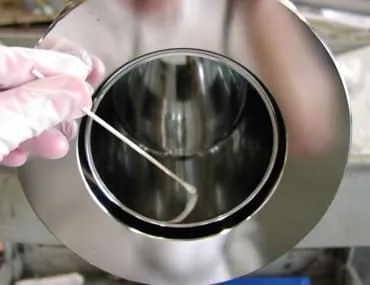
The short answer: Hastelloy is specified for the environments that destroy stainless steel — hot chlorides, mixed acids, wet chlorine, sour gas — and it earns that reputation only when its surface is clean. Machining, welding, grinding and handling embed iron and leave a work-damaged layer that corrodes first, even on a nickel-chromium-molybdenum alloy. Electropolishing removes that layer, restores the pitting and crevice-corrosion resistance Hastelloy was bought for, and leaves a smoother, brighter, deburred surface. Harrison has electropolished Hastelloy grades since 1980 with process parameters set for the alloy rather than borrowed from stainless.
Grades we electropolish
Hastelloy C-276 and C-22 are the most common; other Hastelloy grades and the equivalent nickel-chromium-molybdenum alloys such as Alloy 625 are processed with parameters set for the alloy. Hastelloy is a registered trademark of Haynes International. For the broader nickel family, see nickel alloy electropolishing.
What electropolishing does for Hastelloy
Restores corrosion resistance. Dissolves the embedded iron, inclusions and smeared metal that fabrication leaves behind, so the alloy's resistance to pitting, crevice corrosion and stress-corrosion cracking is as designed.
Removes rouge and heat tint. Weld discoloration and process rouge dissolve with the surface layer.
Lowers surface roughness. Peaks dissolve first, improving Ra and leaving a surface that holds less product and cleans faster.
Deburrs without distortion. Burrs and sharp edges carry the highest current density and are removed in the same cycle, with no mechanical contact.
Brightens. Hastelloy parts often arrive dull from heat treatment and welding; electropolishing returns a lustrous, non-directional finish.
Typical Hastelloy work
Reactor and column internals, heat-exchanger tubes and bundles, valve bodies and trim, pump casings and impellers, scrubber and flue-gas components, chemical-process piping and fittings, and pharmaceutical and fine-chemical equipment in C-22. Parts run from batches of small machined components to large fabrications handled with four overhead cranes and 15,000 lb material-handling capacity in Houston, or on-site for installed equipment.
Where a part needs passivation, mechanical polishing to a certified Ra, or oxygen cleaning instead of or in addition to electropolishing, see Hastelloy under materials.
Request a Quote · Call 800-245-5707
- More to Know
Frequently Asked Questions

Services
Resources
13002 Brittmoore Park Dr
Houston, TX 77041-7231
Phone: 800-245-5707