Harrison C-75: Proprietary Polishing for Product Adhesion and Buildup
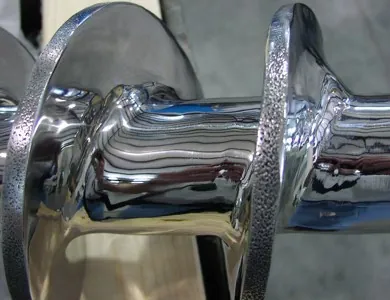
The short answer: Harrison C-75 is a proprietary two-stage finishing process, developed by Harrison Electropolishing in 1980, that combines precision mechanical polishing with electropolishing to produce an exceptionally smooth, cleanable surface on stainless steels and nickel-based alloys. It exists for one problem: product that sticks. Where pellets, powders, resins, slurries or viscous product build up on conveyor screws, rotary valves, hoppers, chutes, dies and vessel interiors, a C-75 surface lets the product release, so transfer rates go up, cleaning intervals get longer and cleaning itself takes less time. It was designed for the petrochemical industry and has since been used in industrial and high-purity applications on five continents.
Why two stages
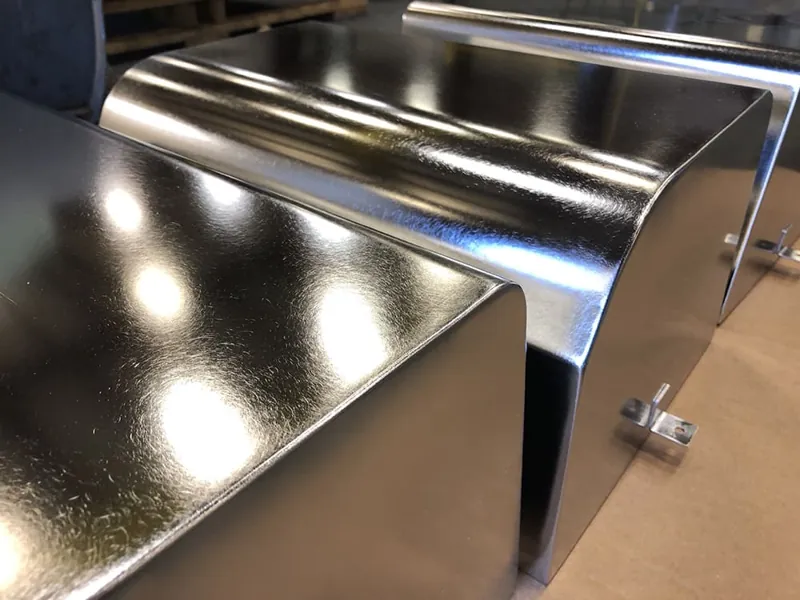
Electropolishing alone improves a surface by about half its starting Ra. On an as-fabricated or as-cast product-contact surface that is not enough to stop adhesion. The C-75 process starts with precision mechanical polishing — using tooling, equipment and techniques Harrison developed for product-contact geometry such as screw flights, valve rotors and hopper cones — to bring the surface to a very low Ra. Electropolishing then removes the smeared, stressed layer that mechanical polishing leaves, dissolves embedded abrasive and iron, and levels the remaining micro-peaks. The finished surface is smoother than either process produces alone, chromium-enriched and passive, with no directional lines for product to key into.
Where C-75 is used
Conveyor screws and feeders. Flights, shafts and troughs where polymer pellets, powders and sticky intermediates build up; see reducing conveyor screw adhesion.
Rotary valves and airlocks. Rotors and housings where buildup causes jamming and leakage.
Hoppers, chutes, silos and bins. Cones and walls where bridging and rat-holing stop flow.
Dies, mixers, extruder components and vessel interiors. Product-contact surfaces in polymer, petrochemical, food, pharmaceutical and chemical processing.
C-75 is specified by petrochemical and polymer producers most often, and by food, pharmaceutical and chemical processors with the same adhesion problem.
What to expect
Send the component, the alloy, the product that is building up and the finish or problem you are solving. Harrison will confirm whether C-75, electropolishing alone or mechanical polishing alone fits, quote within one business day, and ship the finished part with a certificate of conformance and Ra readings. Large equipment is handled in Houston with four overhead cranes and 15,000 lb material-handling capacity; installed equipment can be processed on-site across the Houston area and the Gulf Coast.
Request a Quote · Call 800-245-5707
- More to Know
Frequently Asked Questions

Services
Resources
13002 Brittmoore Park Dr
Houston, TX 77041-7231
Phone: 800-245-5707