What Is Electropolishing?
Reviewed by Tom Harrison, member of the ASME BPE Surface Finish Subcommittee · Updated October 2026
The short answer: Electropolishing is an electrochemical process that removes a thin, controlled layer of metal from a part's surface — typically 0.0003 to 0.003 inch — by making the part the anode in an electrolyte bath and applying DC current. Metal dissolves fastest from the microscopic peaks, so the surface gets smoother, burrs disappear, and embedded iron and inclusions go with them. What is left is a bright, chromium-enriched, passive surface that resists corrosion, cleans more easily and holds less product. It is the reverse of electroplating: instead of adding metal, it takes it away.
How the process works
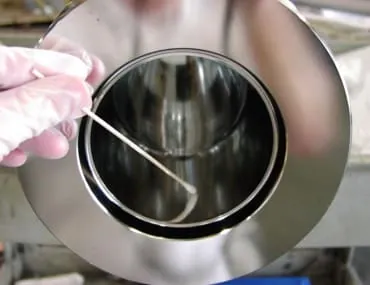
The part is fixtured, connected as the anode and submerged in a heated electrolyte with a cathode shaped to its geometry. When DC current is applied, metal ions dissolve from the part's surface into the electrolyte. The key is current density: within the microscopic surface profile, current concentrates at the high points and thins out in the valleys, and the reaction rate follows the current. The peaks dissolve faster than the valleys, so the surface levels itself. After the electropolishing cycle, the part goes through neutralizing, rinsing, cleaning and drying steps, and for high-purity work, cleanroom inspection and packaging.
How much metal comes off depends on cycle time and the part's dimensional tolerances; Harrison controls removal between 0.0003 and 0.003 inch and will work to the tolerance on your drawing. Because no tool touches the surface, there are no directional polishing lines, no smeared metal and no risk of distortion, and the hardness of the material has no bearing on processing time.
What electropolishing does to the surface
Smooths it. Removing the peaks can improve a profilometer Ra reading by up to 50 percent versus the starting surface.
Deburrs it. Current density is highest on burrs and sharp edges, so burrs up to about 0.002 inch dissolve during the same cycle; larger burrs are mechanically polished first.
Cleans it chemically. Free iron, inclusions and abrasive particles embedded by machining, welding and polishing are dissolved out of the surface.
Changes the surface chemistry. Iron dissolves preferentially, leaving the surface richer in chromium. The passive oxide that re-forms is thicker and more uniform, which is why an electropolished surface resists pitting, crevice corrosion and rouging better than the same alloy mechanically polished to the same Ra. See the benefits of electropolishing for the numbers.
What can be electropolished
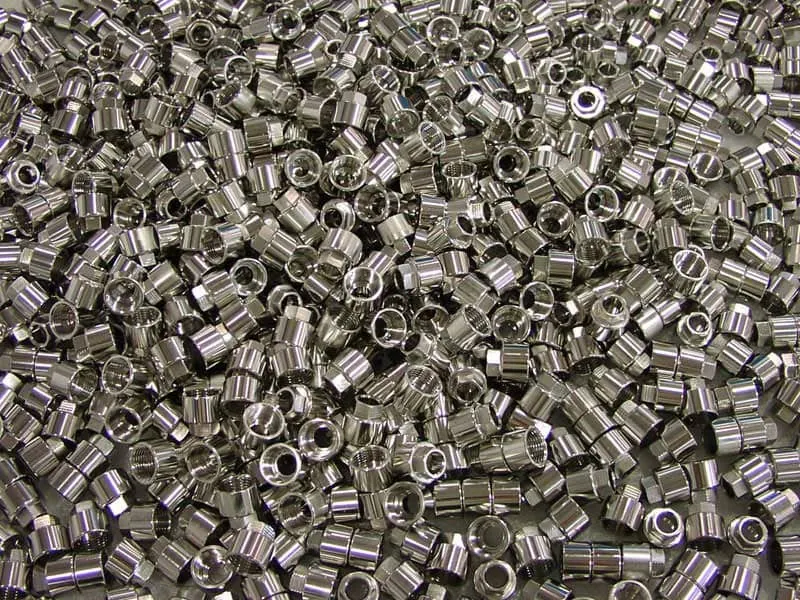
Most of Harrison's work is 300-series stainless steel — 304, 316 and 316L — along with duplex and super duplex, 17-4 PH, 6Mo alloys such as AL-6XN, and nickel alloys including Hastelloy, Inconel and Monel. Titanium and carbon steel are mechanically polished or passivated rather than electropolished. Details by material are on the materials pages.
Typical parts range from fittings, valve bodies and small machined components run in batches to tubing, manifolds, vessels, reactors and complete skids. Harrison's Houston facility runs four full-time electropolishing lines with four overhead cranes and 15,000 lb material-handling capacity, and parts too large or too fixed to ship are electropolished on-site.
The standards
ASTM B912 — Standard Specification for Passivation of Stainless Steels Using Electropolishing. SEMI F19 — wetted surface finishes of electropolished 316L components for semiconductor gas systems. SEMI F17 — high-purity electropolished 316L tubing and fittings. ASME BPE — surface-finish designations SF4–SF6 for bioprocess equipment; see ASME BPE specifications. Work can also be done to your company specification, with Ra readings and a certificate of conformance on every job.
When to specify electropolishing
Specify it when the surface has to be cleanable, non-particulating, corrosion-resistant or free of burrs without mechanical work — hygienic and high-purity process equipment, UHP gas systems, product-contact surfaces where buildup is a cost, fragile or detailed parts that cannot be tumbled, and any stainless fabrication that has to survive chloride, sour or seawater service. Where corrosion resistance is the only requirement and the surface texture does not matter, passivation may be enough; the electropolishing vs passivation page walks through the choice.
Request a Quote · Call 800-245-5707
- More to Know
Frequently Asked Questions

Services
Resources
13002 Brittmoore Park Dr
Houston, TX 77041-7231
Phone: 800-245-5707